Night Dreamer

by Paul Burmeister

It's hard for me to agree with anyone who thinks Wayne Shorter is not among the most important jazz figures of the 1960s. I prefer him over other candidates because of his important contributions as a sideman, and did any bandleader in the decade, other than Miles Davis, produce evidence that was as consistently excellent? A composer, player, and leader, Shorter participated in many of the most important movements, with the exception of free jazz. His own albums on Blue Note and his recordings with Miles Davis' quintet are proof enough of his high ranking. Another measure, for this writer, is my opinion that Shorter brought out the best in Elvin Jones, which might be blasphemy to those of you who prefer Coltrane and Jones.

Night Dreamer, recorded in 1964, is my favorite from his string of outstanding Blue Note releases. Featuring Lee Morgan, Reggie Workman, Jones, and McCoy Tyner (curiously listed as "Etc." on the cover), the album presents six solid originals, including the familiar title tune and "Black Nile." There are two takes of "Virgo"—both are very good. My recommendation for a playlist is the beautiful "Oriental Folk Song."

Shorter Night Dreamer cover.jpg

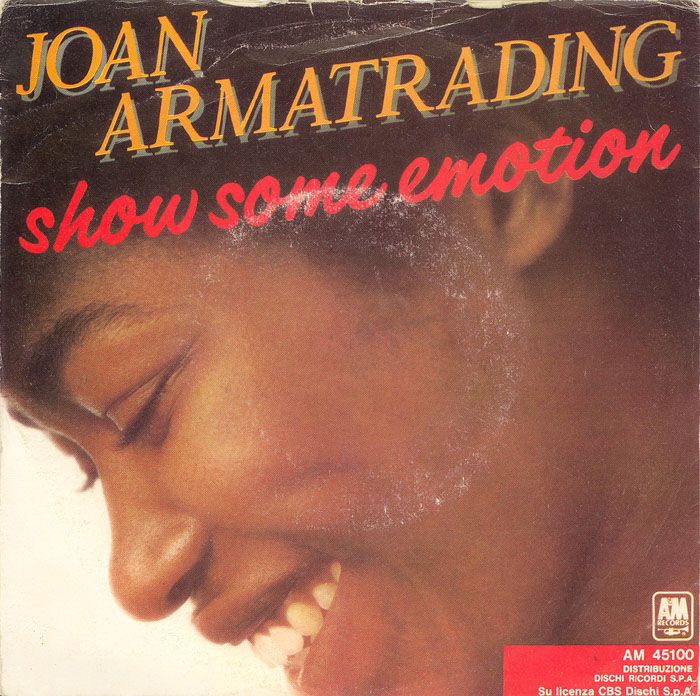
"Show Some Emotion"

by Paul Burmeister

At 3:31 the title cut of Joan Armatrading's 1977 album Show Some Emotion is easily under the four-minute requirement of a perfect pop tune. It also has a sweet melody and just enough emotional force. I'm surprised Armatrading's gem has not been covered often, because it seems like a great vehicle for a variety of possibilities. If you're among the few that are familiar with Armatrading's original, you should also check out Vicki Genfan's 2008 acoustic version.
In short I recommend "Show Some Emotion" to everybody's mix. Armatrading's voice, full of stance and nuance (Robert Christgau), should please most people, and the simple, bluesy production has aged well.

Armatrading 45.jpg

Time lapse judgment

by Paul Burmeister

When Police released Ghost in the Machine in 1981 I was excited to review it for the college newspaper. My memory is I was cool to it, or cooler to it than Police's preceding album, Zenyatta Mondatta. Later Synchronicity became my favorite release by this group, and I forgot about Ghost.
But almost 40 years have passed, and I'm listening to Ghost (remastered) again, not having returned to it until now. I'm not sure what has changed during that time; me certainly, but what about me in relation to changes of judgment? I'm can't find a reason not to like anything about the serious fun that is Ghost in the Machine. The music has aged as well as the great cover art. I know a little about the group's dynamics and its move away from the raw trio sound, but I can put all of that out of mind and listen to this, from start to finish, and over and over.
Favorite cuts for a playlist: the first and the last—"Spirits in the Material World" and "Darkness."

Wow! rarely

by Paul Burmeister

When a person has lived as long as I have and sampled as much music as I have, it becomes less frequent that "something new" causes a Wow! reaction. And yet, the less frequent occasion is still as potent and still as humbling as the more common Wows of one's youth.
Sun Ra, Super Sonic Jazz, 1956—Wow! I have seen Pat Patrick play (in concert with NRBQ in the 80s) and I am familiar with Julian Priester and Charles Davis, but my previous exposure to the Arkestra as an ensemble was from later recordings. My previous exposure was not as compelling as this session, which could be explained by my ears being not as open or experienced.
If you haven't been exposed to Sun Ra and His Arkestra, I recommend this date; it's paired with Fate in a Pleasant Mood, from 1961. Both sessions are very enjoyable.